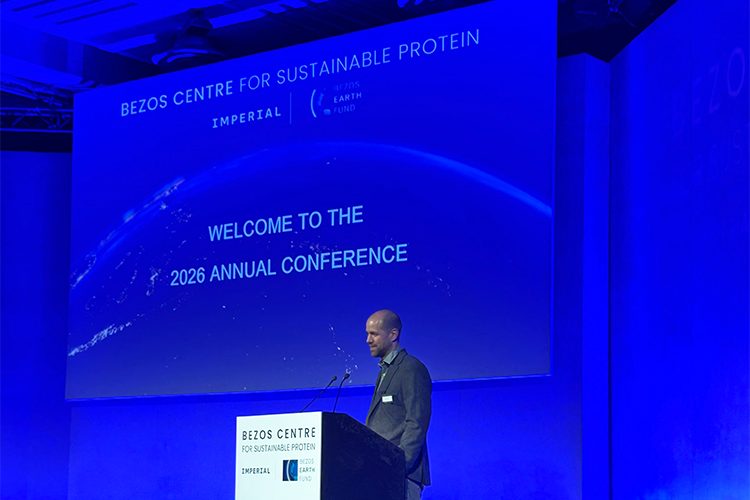
A week on from the Bezos Centre for Sustainable Protein 2026 Conference in London, New Food Deputy Editor Ben Cornwell reflects on the ideas, debates and breakthroughs that defined the event and why the future of alternative proteins still hinges on three stubborn challenges: taste, cost and trust.
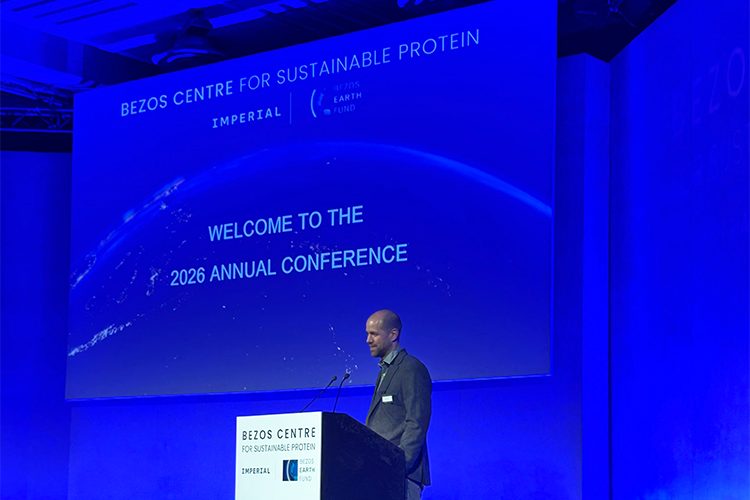
Professor Rodrigo Ledesma-Amaro, Director of the Bezos Centre for Sustainable Proteins opening the 2026 Conference.
A week after the Bezos Centre for Sustainable Protein Conference in London, one conclusion stands out. For all the scientific momentum behind alternative proteins, the industry is still grappling with the same three challenges.
Taste. Cost. Trust.
Across two days at the QEII Centre, more than 600 scientists, startups, investors and policymakers gathered to discuss technologies reshaping how food could be produced in the coming decades, from precision fermentation and microbial proteins to cultivated meat and AI-driven bioprocessing.
The pace of innovation is undeniable. Yet stepping back from the presentations and panels reveals a striking pattern. For all the progress in food biotechnology, the fundamental barriers facing next-generation food technologies remain largely unchanged.
Biology doesn’t scale neatly. You can’t just build a bigger fermenter and it will know your work.”
Until those three conditions are met simultaneously, alternative proteins will struggle to move beyond early adoption and into mainstream food systems.
Many of the conversations at the conference ultimately returned to a single underlying issue. Progress in the sector now depends on how quickly these technologies can move from scientific breakthroughs to scalable food production.
As Bruce Friedrich of the Good Food Institute warned in his keynote, there is effectively “no plan B” for curbing rising global meat demand without alternative proteins achieving price and taste parity.
Biology is advancing faster than ever
If there was one clear takeaway from the conference, it was the incredible speed at which the scientific foundations of food biotechnology are advancing.
Engineering biology, automation and artificial intelligence are rapidly changing how researchers design biological systems. Professor Paul Freemont of Imperial College London described DNA as increasingly functioning as “a programmable material,” allowing scientists to design and test thousands of genetic variations in parallel.
At the same time, the economics of biological research have shifted dramatically. Genome sequencing that once cost billions can now be done for less than $100, generating vast biological datasets and accelerating AI-driven modelling of metabolic pathways.
That convergence between biology and computation is already reshaping how new food ingredients are developed. Dr Lucy Colwell, Research Scientist at Google DeepMind, explained how machine learning is beginning to transform biological discovery, from predicting protein structures to modelling complex cellular systems.
One area where these advances are becoming particularly visible is fermentation.
As Professor Rodrigo Ledesma-Amaro, Director of the Bezos Centre for Sustainable Proteins, noted, fermentation itself is nothing new.
“Fermentation has been around for millennia. One third of our diet is fermented food – beer, kimchi, wine, cheese.”
What is changing is the level of control biotechnology now offers over these processes.
“We can add specific molecules we want and remove specific molecules we don’t want,” he said.
This control has shifted the role of fermentation from one of preservation to high-value and high-spec ingredient factories, designing compounds with specific nutritional, sensory and functional properties.
Scaling remains the industry’s hardest problem
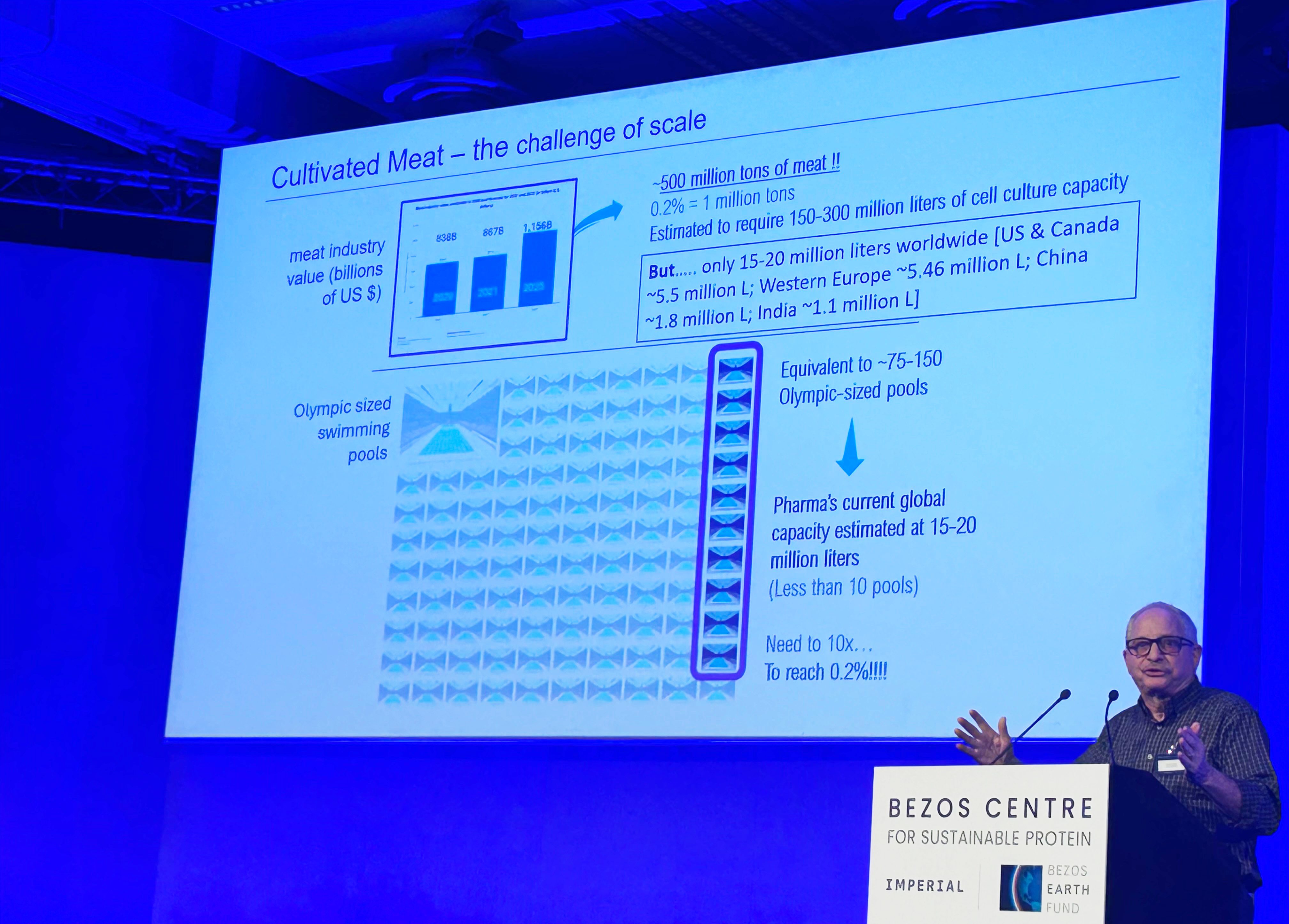
Professor David Kaplan of Tufts University speaking on the challenges of scaling cultivated meat.
Yet even as the science advances rapidly, another theme surfaced repeatedly throughout the conference: how these technologies can be scaled beyond the laboratory.
Biological systems that behave predictably in research environments often react very differently once production moves to industrial facilities.
As Dr Izzy Webb of the UK Department for Science, Innovation and Technology observed during a panel discussion at the conference:
“Biology doesn’t scale neatly. You can’t just build a bigger fermenter and it will know your work.”
That reality raises a broader question about how the industry should scale. In his own talk at the conference, Professor David Kaplan of Tufts University argued the answer could shape the structure of the future food system itself.
“If we go the way of scale-up, we’re going down the path of becoming a few mega food companies in the future, because it’s going to cost too much to run these large scales.”
Instead, Kaplan suggested the industry should also explore “scaling out”, distributing production across smaller facilities located closer to where food is consumed.
“These would be scalable to individual communities, perhaps even homes, small cities, [to] avoid food deserts, and so on.”
Some innovators are already beginning to experiment with approaches that resemble this distributed model.
One example discussed during the conference was Respect Farms, which has launched what it describes as the world’s first cultivated meat farm on a working dairy farm in the Netherlands. The project is exploring how small-scale cultivated meat production units could be integrated into existing agricultural infrastructure, allowing farmers to produce cell-based meat alongside traditional farming activities.
Rather than concentrating production in massive industrial facilities, the pilot is designed to investigate whether cultivated meat could eventually be produced through a distributed network of smaller sites. Such a model could help keep farmers involved in the protein transition.
The project remains at an early stage, with the first farm serving largely as a proof of concept. Still, it reflects a broader debate emerging across the sector. Will cellular agriculture rely on large, centralised manufacturing plants or a network of decentralised production systems?
Taste still decides the outcome
Even if manufacturing riddles can be solved, technological capability alone will not determine success.
Consumer acceptance will.
That reality surfaced repeatedly during discussions about product development. Ultimately, alternative proteins must compete not only on sustainability but also on sensory performance.
One promising area of research presented during the conference focused on cultivated fats. Researchers reported early evidence that the aroma of lab-grown pig fat, when cooked, was not objectively different from conventional pig fat – an encouraging sign for product developers.
Regulation is existential for innovators…
I agree, but in a positive way; because without good regulation you can’t build the consumer trust and confidence that something new they’ve not encountered before is safe to eat.”
Fat plays a critical role in flavour, mouthfeel and cooking behaviour. Replicating these properties has long been one of the most difficult hurdles for alternative proteins. If cultivated fats can recreate those sensory characteristics, they could help close the taste gap that slowed adoption of many early plant-based products.
At the same time, speakers suggested the industry may need to rethink how flavour development is approached.
Too often, products are assembled first and evaluated for taste later. By that stage, the sensory profile may already fall short of consumer expectations.
Increasingly, researchers argue that taste, texture and nutrition must be designed earlier in the development process using advanced analytical tools, metabolomics and predictive modelling.
Building trust beyond the lab
Alongside taste and cost, trust emerged as the third major theme throughout the event.
Public awareness of emerging food technologies remains limited. When surveyed about engineering biology, many consumers simply report that they do not recognise the term.
Referencing an earlier remark during the conference, Rebecca Sudworth, Director of Policy at the Food Standards Agency, said:
“Regulation is existential for innovators, I agree, but in a positive way; because without good regulation you can’t build the consumer trust and confidence that something new they’ve not encountered before is safe to eat.”
That unfamiliarity creates both risk and opportunity.
Without clear communication and transparent regulatory frameworks, novel foods could face the same public resistance that once surrounded genetically modified crops. Early engagement and robust safety standards may allow the sector to build consumer confidence instead.
Ultimately, trust may prove just as important to the future of alternative proteins as the technologies themselves.
A sector entering its next phase
Looking back on the conference a week later, one conclusion feels unavoidable.
The early years were defined by scientific breakthroughs.
Researchers proved that cells could be cultivated, microbes engineered and entirely new food ingredients created.
The next phase will depend far less on discovery and far more on execution.”
The alternative protein sector is entering a new stage of development.
The early years were defined by scientific breakthroughs. Researchers proved that cells could be cultivated, microbes engineered and entirely new food ingredients created.
The next phase will depend far less on discovery and far more on execution.
Manufacturing infrastructure, fermentation capacity, supply chains and regulatory clarity will determine how quickly these technologies move beyond pilot projects and into everyday food production.
Laboratories alone will not shape the future of food biotechnology. Factories, regulators and consumers will all play decisive roles.
Scaling Biotechnology and Novel Foods report coming next week
The conversations in London revealed a sector moving rapidly from scientific promise to industrial reality.
Next week, New Food will explore that transition in greater depth with the release of Scaling Biotechnology and Novel Foods, a special report examining the engineering, regulatory and commercial forces shaping the future of food innovation.
Featuring insights from experts at the Bezos Centre for Sustainable Protein, Food Standards Agency, Danone and other leaders across industry and policy, the report will unpack the opportunities and complexities facing the sector as it attempts to scale.
Related topics
Alternative Proteins, Data & Automation, Environment, Fats & oils, Food Security, Health & Nutrition, Ingredients, New product development (NPD), Plant based, Product Development, Proteins & alternative proteins, Regulation & Legislation, Research & development, Sensory technology, Sustainability, The consumer, Trade & Economy, World Food


мелбет казино скачать на андроид
Установить приложение Melbet: APK, iOS и компьютер
Мобильная версия Melbet включает ставки и казино в едином приложении. Доступны live-ставки, слоты, онлайн-трансляции, статистика и операции по счёту. Загрузка занимает несколько минут.
Android (APK)
Загрузите APK с официального сайта, откройте файл и завершите установку. При необходимости включите доступ к установке сторонних приложений, затем авторизуйтесь.
iOS (iPhone)
Откройте App Store, введите в поиске «Melbet», нажмите «Получить», после установки авторизуйтесь в системе.
ПК
Откройте официальный сайт, авторизуйтесь и создайте ярлык на рабочий стол. Браузерная версия функционирует как полноценное приложение.
Функционал
Live-ставки с мгновенным обновлением линии, казино и слоты, просмотр матчей, аналитические данные, уведомления о матчах, регистрация за минуту и поддержка 24/7.
Бонусы
После установки доступны бонус на первый депозит, промокоды и фрибеты. Правила начисления определяются регионом.
Безопасность
Скачивайте только с официальных источников, контролируйте адрес сайта, не сообщайте данные доступа третьим лицам и включите 2FA.
Установка занимает несколько минут, после чего открывается полный доступ Melbet.
Бро, доброго дня. В личку реквы на оплату жду, на сайт тоже попасть не могу… https://gidrocity-service.ru CHM-500 и CHM-1000Я уже начал сомневаться,что проблема в курьерке!Я им звонил,они в свою очередь звонили в головной офис-про мой трек они даже не слышали!!!А постановление вроде ещё не вступило в силу.
For reports
how to buy generic keflex without insurance
for proven strategies.