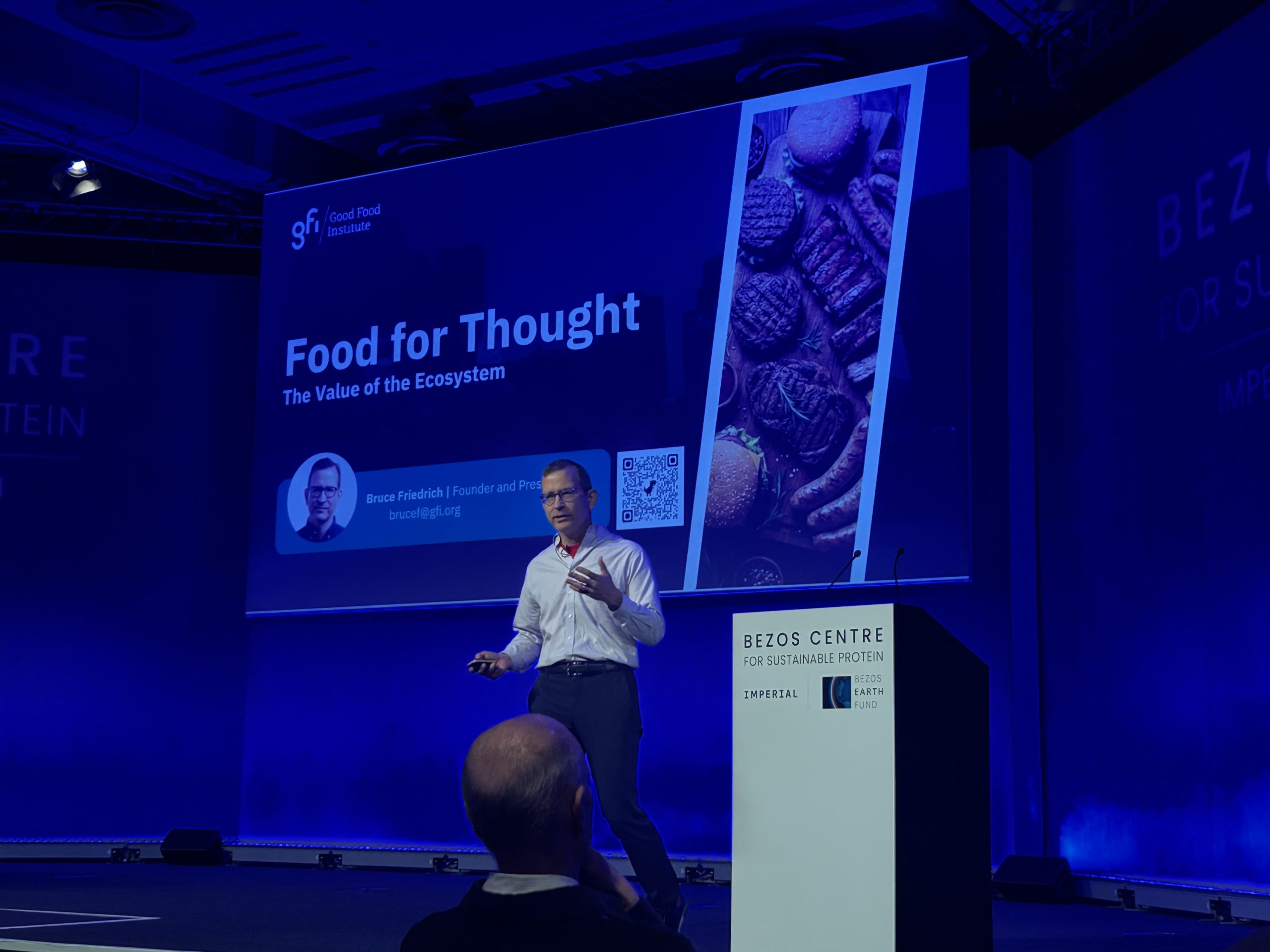
In his keynote, GFI President Bruce Friedrich told the Bezos Centre for Sustainable Protein 2026 Conference that meat demand will rise unless alternative proteins reach price and taste parity.
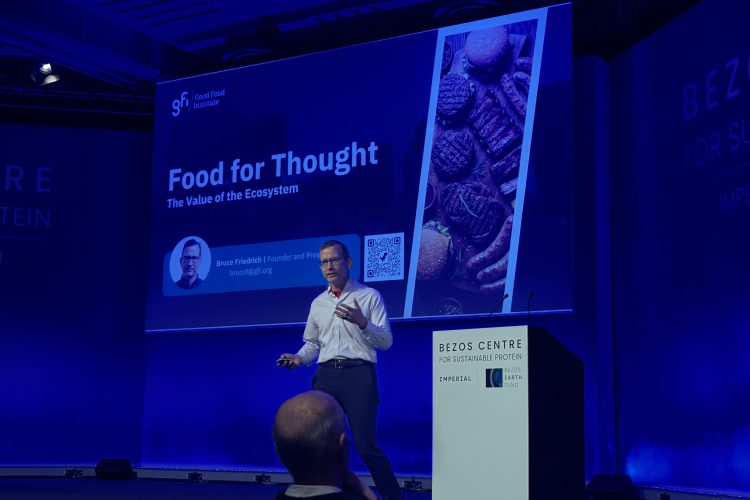
Bruce Friedrich, President of the Good Food Institute (GFI) and author of Meat, giving his keynotes speech at the Bezos Centre for Sustainable Proteins 2026 Conference.
There is “no plan B” to curb rising global meat consumption without delivering alternative proteins that achieve price and taste parity, Bruce Friedrich warned in his keynote at the Bezos Centre for Sustainable Protein Conference in London.
Speaking today at the Queen Elizabeth II Conference Centre on day two of the 2026 event, the President of The Good Food Institute (GFI) and author of Meat highlighted that meat consumption has increased every year since 1961 and continues to set new records.
“The first point is that there is no plan B. Meat consumption is doing this. It’s going up and up and up,” he said. Since the UN’s Food and Agriculture Organization began tracking the data, consumption has “gone up every single year, literally a new global record every single year”.
With GDP and population growth driving further expansion, Friedrich framed the challenge as structural rather than behavioural, warning that rising demand intensifies environmental and public health pressures.
“For 12,000 years, we’ve been growing crops to feed them to animals so that we can eat animals,” he noted, highlighting the resource intensity and land use implications of the system.
Against that backdrop, he dismissed behaviour change alone as sufficient to shift aggregate demand. “What’s being done to change meat’s upward trajectory? It’s basically this: it’s let’s convince people to eat something different… But what it hasn’t done is change meat’s upward trajectory. It just keeps going up.”
Instead, Friedrich argued that achieving parity is essential.
We need something that scales globally, and diet change doesn’t. And we need to replace like for like. Price and taste parity are required. This has to be part of what it is that we’re working on.”
Innovation cycle, not sector collapse
Turning to recent scepticism around plant-based and cultivated meat, Friedrich acknowledged the negative headlines. “There are an awful lot of obituaries being written about plant-based and cultivated meat.”
However, he framed recent turbulence as typical of disruptive innovation, saying “This is what innovation looks like.”
To reinforce the point, he drew on historical parallels. Between 1900 and 1910, more than 500 car companies failed before the automotive industry scaled. During the dotcom crash, the NASDAQ lost around 80 percent of its value, more than half of internet firms went bankrupt and Amazon saw its valuation plunge before rebounding. Even 11 years ago, he noted, the International Energy Agency saw limited potential for solar and electric vehicles to materially reduce emissions.
Friedrich used these examples to illustrate how early-stage industries often face high failure rates before scaling.
A decade ago, he reminded delegates, “there was no Impossible Burger. There was no Beyond Burger.” Today, he notes, billions have been invested globally in alternative proteins and more than 20 governments are funding research and development in the space, largely driven by economic competitiveness and food security priorities.
Even so, Friedrich stressed that scaling alternative proteins will require overcoming significant scientific and engineering challenges, particularly on the plant-based side.
Closing his keynote, Friedrich placed responsibility squarely on the room:
Every single one of you could be the difference between this working and not working… If you’re in this room, you’re part of that revolution.”
Related topics
Alternative Proteins, Cultured Meat, Environment, Food Security, Ingredients, Plant based, Product Development, Research & development, Sustainability, Technology & Innovation, Trade & Economy, World Food

Современный мир высоких технологий предлагает большое разнообразие вариантов регистрации доменных имен. Среди популярных сочетаний выделяется простая и выразительная комбинация `slon1`. Именно такая последовательность стала основой множества доменных адресов, привлекающих внимание пользователей. Простота восприятия делает её идеальной для брендов и веб-ресурсов различного назначения.
slon9 cc
Одним из интересных направлений стало использование национального домена верхнего уровня (.cc). Таким образом появилось популярное сочетание **slon1.cc**, которое сочетает простую и доступную ассоциацию со словом «слон» и одновременно обозначает принадлежность ресурса к определённой географической зоне. Такое решение способствует быстрому восприятию и идентификации сайта пользователями.
ссылка на кракен официальный
Еще одним вариантом стал вариант **slon1.at**, в котором подчеркнута связь с австрийским сегментом сети Интернет. Такой выбор тоже имеет свою специфику и добавляет дополнительные смыслы в восприятие бренда. Благодаря своим уникальным характеристикам этот тип домена активно используется компаниями, ориентированными на европейский рынок.
ссылка на кракен сс
Часто владельцы ресурсов выбирают и сокращённую форму записи своего имени. К примеру, такое написание, как **slon1cc**, придаёт сайту дополнительный шарм и облегчает процесс запоминания. Подобная форма часто встречается в международной практике брендирования и отражает общую тенденцию упрощения структуры именования.
кракен ссылка kraken
В заключение отметим ещё одну разновидность написания домена — **slon1сс**. Здесь упор сделан на двойное повторение буквы «с», что создаёт особое звучание и запоминающийся эффект. Такая игра букв усиливает привлекательность домена и выделяет ресурс среди прочих аналогичных предложений.
kraken даркнет рынок ссылки
https://slon1.ca
ссылка кракен онион