The new global partnership will drive sustainable agriculture, biodiversity conservation and climate resilience across farming and food production systems.
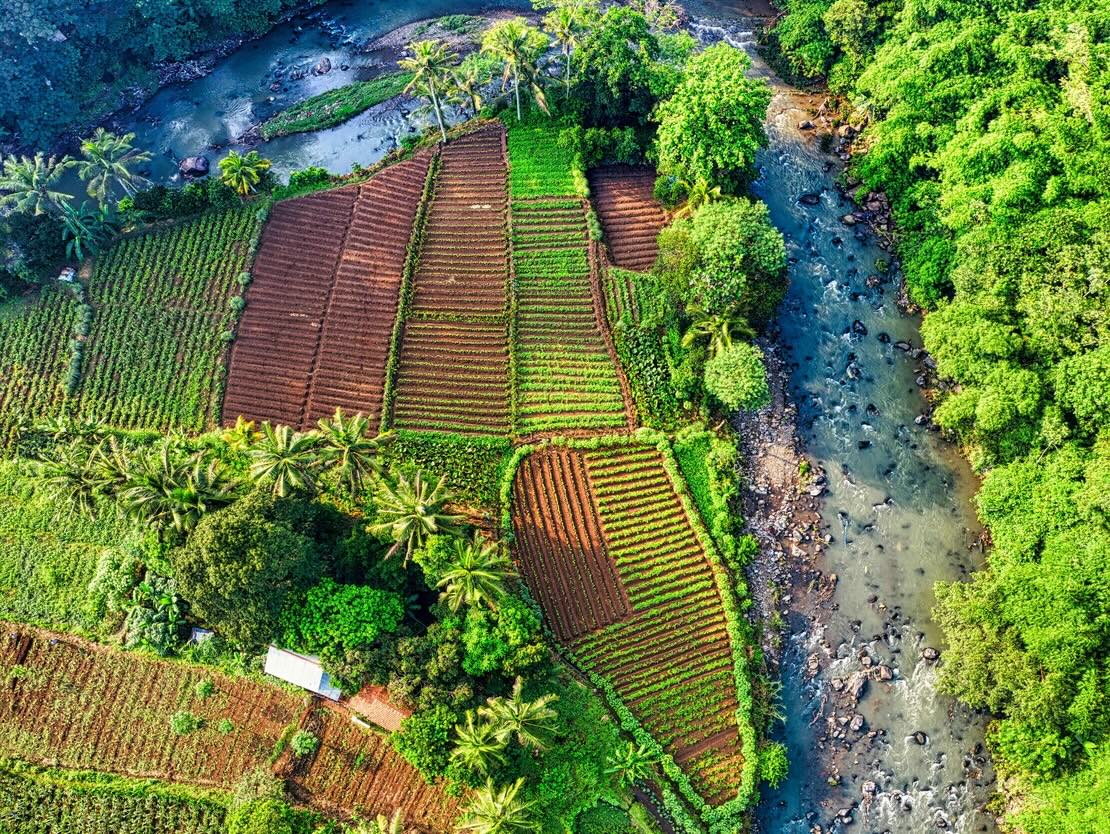
Green Trees and Farmland, West Java, Indonesia. Credit: Tom Fisk
The International Union for Conservation of Nature (IUCN) and CGIAR have signed a Memorandum of Understanding (MoU) to accelerate the transition towards nature-positive global food and agricultural systems.
The agreement comes at a pivotal moment as food security, biodiversity loss and climate change increasingly converge to challenge global agriculture. In response, both organisations have committed to deepening collaboration on sustainable production landscapes, ecosystem restoration and the transformation of farming systems worldwide.
This shift is critical because an estimated one billion people rely directly on nature for their livelihoods through farming, fishing and forestry. As a result, food security and rural economies remain fundamentally dependent on healthy ecosystems, placing biodiversity at the heart of long-term agricultural productivity and resilience.
Scaling up science, policy and restoration
To address these interconnected pressures, IUCN and CGIAR will expand joint action on multifunctional landscapes, land restoration, sustainable farming and livestock systems, climate change mitigation and adaptation, and water resource management. Alongside this, the partnership will strengthen policy advocacy, support biodiversity-friendly value chains, generate shared knowledge and help advance implementation of the Rio Conventions.
Dr Grethel Aguilar, IUCN Director General, said:
Nature is the foundation of our food systems and of human wellbeing itself. Every meal we eat, our livelihoods, and the resilience of our economy depend directly on healthy ecosystems.
As we confront the intertwined challenges of climate change, biodiversity loss, and food security, this partnership with CGIAR is more important than ever.
It reflects a shared commitment to advance nature-positive agriculture – where production works with nature, not against it – ensuring that people, biodiversity, and food systems thrive together for generations to come.”
Echoing this, Dr Ismahane Elouafi, CGIAR Executive Managing Director, added:
This MoU underscores the importance of cooperation in addressing the complex and increasingly interlinked global challenges we face today.
By combining our strengths, we can accelerate the adoption of integrated and holistic approaches to sustainable agriculture and biodiversity conservation.”
The partnership builds on clear institutional strengths. CGIAR, established in 1971, contributes scientific leadership and field-based innovation to transform food, land and water systems amid the climate crisis. Complementing this, IUCN brings global convening power, policy influence and Commission-based expertise in conservation and sustainable development, enabling the organisations to better connect science, policy and practice at scale.
Momentum for change is already building. At the 2025 World Conservation Congress, IUCN members approved a new 20-Year Strategic Vision, including a mandate to support food and agricultural systems transformation. Reflecting growing global focus, seventeen resolutions on food and agriculture were adopted, including Resolution 002 calling for “Accelerating action for nature-positive, sustainable agriculture and food systems”.



дистанционное обучение по школьной программе дистанционное обучение по школьной программе .
Информационный портал о способах заработка и развитии бизнеса предлагает практические руководства для увеличения дохода. Читатели получают последовательные рекомендации по созданию накоплений, ведению личного бюджета и открытию своего бизнеса. На платформе https://kakzarabotkin.ru/ собраны проверенные методики заработка в интернете, аналитика ставок на спорт и экспертные материалы по страхованию бизнеса. Эксперты размещают свежие публикации о вычислении оборотных средств и тактиках роста компаний для владельцев бизнеса.