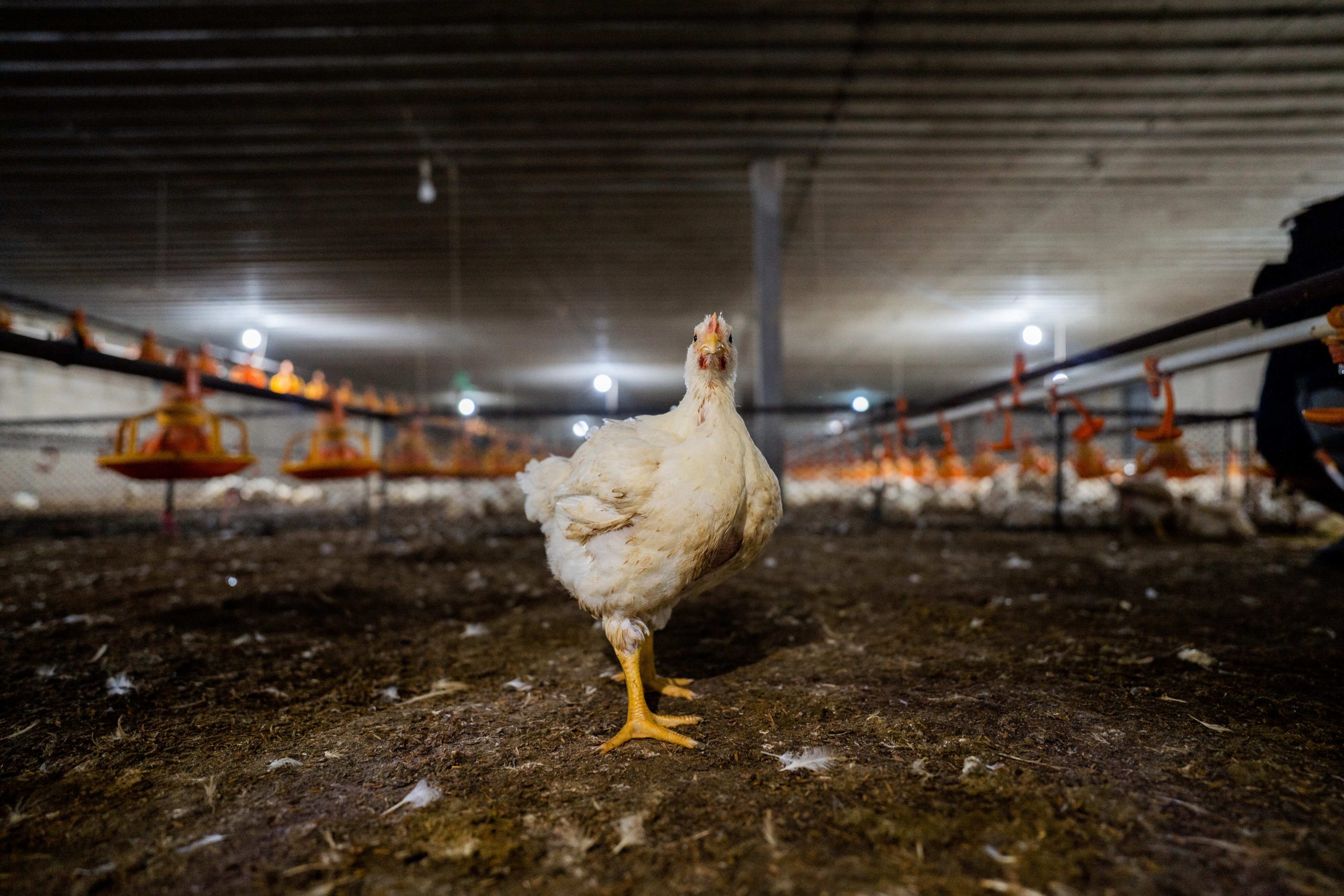
Animal welfare groups accuse fast-food giants of failing to deliver chicken welfare improvements as European Chicken Commitment reforms approach a decisive stage.
Credit: Haig / World Animal Protection / We Animals Media
McDonald’s and KFC are among fast-food companies facing criticism in a new European report for failing to deliver meaningful improvements to chicken welfare, despite years of public commitments.
The Pecking Order 2025 ranking, published this week by a coalition of animal welfare organisations led by World Animal Protection, assesses 81 fast-food companies from 27 different chains operating across seven European countries. The report measures company progress against the European Chicken Commitment (ECC), minimum welfare standards introduced in 2017 and due for full implementation by 2026.
By 2026, the ECC requires companies to ensure that 100 percent of the fresh, frozen and processed chicken in their supply chains meets the following standards:
- Comply with all EU animal welfare laws and regulations, regardless of the country of production
- Implement a maximum stocking density of 30kg/m² or less; thinning is discouraged and, if used, limited to one thin per flock
- Adopt breeds that demonstrate higher welfare outcomes, including approved slower-growing breeds such as Hubbard Redbro (for indoor use only)
- Meet higher environmental standards, including at least 50 lux of light, two metres of perch space and two pecking substrates per 1,000 birds, adherence to Annex 2.3 of the EU Broiler Directive air quality limits, and no cages or multi-tier systems
- Use controlled atmospheric stunning with inert gas or multi-phase systems, or effective electrical stunning without conscious inversion
- Demonstrate compliance through third-party auditing and annual public reporting on progress
With voluntary industry deadlines fast approaching and EU animal welfare reforms expected next year, the NGOs warn that company pledges are failing to translate into real-world change, leaving millions of chickens exposed to poor living conditions.
Promises versus performance
According to the ranking, only 37 of the 81 companies assessed have policies fully aligned with the ECC, while just 31 publish any meaningful data showing whether chicken welfare is actually improving on farms. The report concludes that there is a widening gap between corporate promises and on-the-ground performance.
Dirk Verdonk, Director World Animal Protection Netherlands, said:
Fast-food chains are talking about animal welfare, but the reality for chickens tells a very different story.
Companies are presenting themselves as responsible while failing to show meaningful evidence that conditions for chickens are improving. Consumers are being misled, and chickens continue to suffer unnecessarily, with cruel practices such as intense overcrowding and extremely fast growing breeds, widespread.”
While average scores for company commitments and targets reached 41 percent, performance reporting lagged far behind at just 12 percent, highlighting what the authors describe as a lack of transparency and accountability across the sector.
Major brands including McDonald’s, KFC, Subway, Starbucks and Burger King are identified as showing limited progress. The report singles out McDonald’s for not signing up to the European Chicken Commitment in any European market, despite its scale and influence within foodservice.
One of the most significant shortcomings highlighted in the report is the slow transition to higher-welfare chicken breeds. Widely recognised as the single most impactful way to reduce suffering, breed transition remains extremely limited, undermining corporate welfare claims and exposing chickens to painful health problems linked to intensive breeding for rapid growth.
KFC’s position on breed change illustrates the issue. The report highlights that KFC UK & Ireland announced in late 2024 it will miss its 2026 Better Chicken Commitment pledge to phase out fast-growing broiler breeds. The decision affects operations across the UK and Ireland and is expected to impact other Western European markets where full ECC compliance had previously been promised. Animal welfare organisations are now calling on KFC to publish a clear, time-bound roadmap for breed transition and to recommit to full ECC compliance to prevent backsliding.
2026 deadline looms for EU action
The ranking also reveals wide variation between European markets. France leads the table, with Sweden and Denmark also performing relatively well, while Italy, the Czech Republic, Poland and Romania continue to lag behind.
Looking ahead to the 2026 deadline, the report concludes that voluntary commitments have reached their limits. Without EU-wide legislation mandating higher welfare standards, progress is likely to remain slow and inconsistent, with knock-on risks for both animal and human health.
Verdonk concluded:
2026 will decide the future of chicken welfare in Europe.
Companies have had years to act voluntarily and have failed to deliver. The onus is now on the European Commission to turn broken promises into enforceable protections for animals, such as lowering stocking density and banning the use of extremely fast growing breeds and outlawing other cruel practices.”



https://newmuslim.iera.org/members/1xbet-promocode0/activity/422323/
кракен официальный сайт
кракен маркет тор
кракен тор
Krn
площадка кракен
kraken сайт
кракен ссылка тор
кракен актуальная ссылка
kraken darknet
kraken даркнет
кракен онион
кракен маркетплейс
kraken тор
2krn
https://www.zdravnitza.com/pageear/?kak_delaty_tryuki_na_samokate.html
kraken tor
2krn
кракен маркет даркнет скачать
Krn
кракен онион
площадка кракен
Эта статья предлагает уникальную подборку занимательных фактов и необычных историй, которые вы, возможно, не знали. Мы постараемся вдохновить ваше воображение и разнообразить ваш кругозор, погружая вас в мир, полный интересных открытий. Читайте и открывайте для себя новое!
Подробнее тут – https://vivod-iz-zapoya-1.ru/