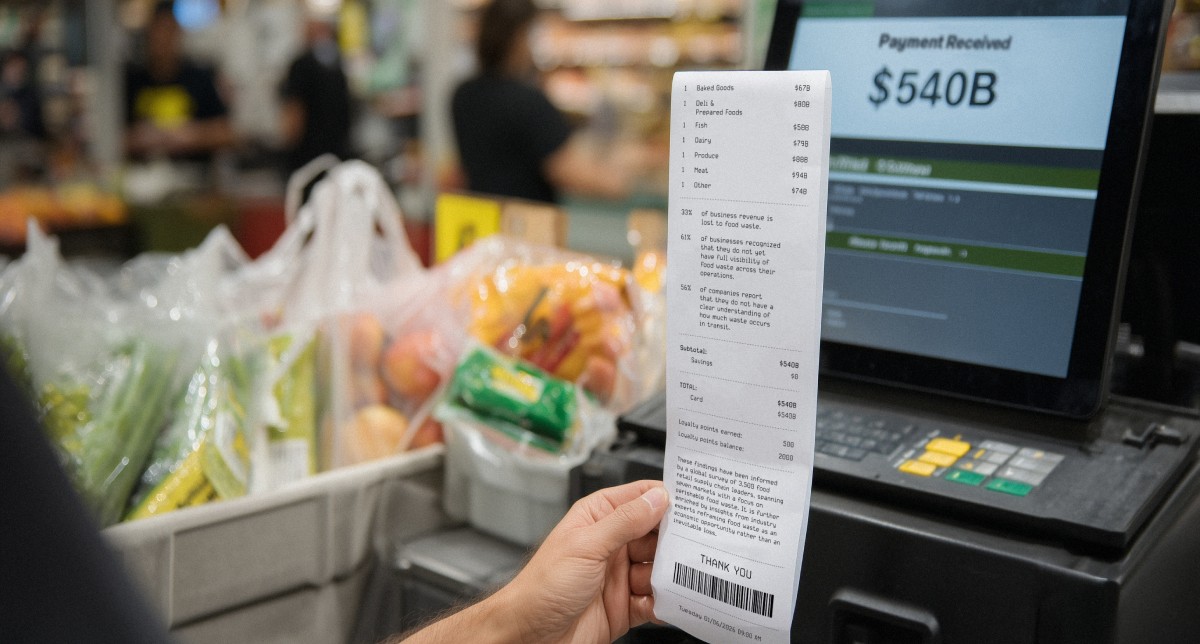
New Avery Dennison research finds global food waste will hit $540 billion by 2026, draining a third of retail revenues and exposing costly supply chain blind spots.

Global food waste is continuing to erode retail margins worldwide, with losses across the food supply chain forecast to reach $540 billion by 2026, according to new research published today by Avery Dennison.
As businesses return from the 2025 holiday trading season, the report Making the Invisible Visible: Unlocking the Hidden Value of Food Waste to Drive Growth and Profitability highlights food waste as one of the most costly, yet least visible, challenges facing food retailers and their supply partners.
Independent economic modelling cited in the report shows the cost of food waste across the global supply chain rising from $526 billion last year to $540 billion by 2026. If current trends continue, cumulative losses between 2025 and 2030 are expected to reach $3.4 trillion, aligning with the 2030 deadline for the UN’s Sustainable Development Goal 12.3 to halve global food waste. Despite this goal, the report uncovered that over a quarter (27 percent) of leaders said that they would not meet the 2030 deadline.
The findings are based on a survey of 3,502 senior decision makers and sustainability leaders across the food retail and wider food value chain, spanning the United Kingdom, United States, Germany, France, China, Brazil and India. Despite heightened awareness, 61 percent of businesses said they still lack full visibility into where food waste occurs across their operations.
According to the report, food waste costs are, on average, equivalent to 33 percent of total revenues each year across the food retail supply chain, from post-farm to point-of-sale.
Perishables and peak trading intensify pressure
Perishable categories remain the most problematic, with half of respondents identifying meat as one of the three most difficult categories for waste, followed by produce at 45 percent and baked goods at 28 percent.
Inventory management is a key contributor, with 51 percent of leaders saying overstocking significantly drives food waste. Transit also emerged as a major blind spot, as 56 percent of companies admitted they do not clearly understand how much food is wasted while goods are being transported.
The challenge intensifies during peak trading periods. Meat has emerged as the single most difficult category overall, with 72 percent of supply chain leaders citing it as their biggest waste concern. Economic modelling forecasts meat waste will account for $94 billion in lost output globally in 2026, nearly one fifth of total annual losses, with fresh produce close behind at $88 billion.
Ahead of peak season trading results, 67 percent of businesses expected meat waste during the holiday season to noticeably reduce margins, while 69 percent said managing waste during this period had become a greater operational concern than in previous years.
Food waste reframed as a business opportunity
Julie Vargas, VP/GM, Enterprise Intelligent Labels Growth at Avery Dennison, said:
Food waste has become an accepted cost of doing business, but it doesn’t have to be. Innovation exists today to help overcome the complexity of food waste by unlocking new possibilities and transforming a historic operating cost into measurable value across the global retail supply chain.
The retail ecosystem is changing, but not enough retailers are changing with it. The biggest challenge is what we can’t see. From transit to shelf, blind spots are silently eroding margins. With the right innovation, we can turn this loss into measurable value and shift the conversation on food waste from being purely seen as a sustainability issue into a business-critical one. This is about unlocking efficiency and growth across the entire supply chain.”
Inflation and shifting consumer behaviour are compounding the issue. Almost three quarters, or 74 percent, of retailers said inflation is making it harder to predict demand for fresh meat, while 73 percent reported growing consumer demand for smaller portions or alternatives.
Michael Colarossi, VP and head of enterprise sustainability at Avery Dennison, added:
For too long, food waste has been positioned almost exclusively as a sustainability and societal issue. We must recognise it as the business opportunity it truly is.
In fact, over seven in ten, or 73 percent, of business leaders told us that they see tackling food waste as a growth opportunity. That’s why the $540 billion in lost value should be a clear call to action for the food retail supply chain to cut waste and boost efficiencies.
Only by uncovering the blind spots in the chain can we take meaningful steps to reduce loss, build resilience and create lasting value for both businesses and the planet.”



Самозанятые водители и индивидуальные предприниматели получают стабильный доход при подключении к парку AREON. Гибкий график работы позволяет самостоятельно планировать время выполнения заказов и выходные дни. Ежедневные выплаты через приложение Яндекс.Про обеспечивают финансовую предсказуемость и оперативный доступ к средствам. Для регистрации потребуется паспорт, водительские права категории B и разрешение на деятельность такси. Более подробная информация о тарифах и условиях размещена на https://parkareon.ru/ для всех желающих. Повышенные тарифы Комфорт+ и Бизнес доступны после прохождения специального тренинга и собеседования.