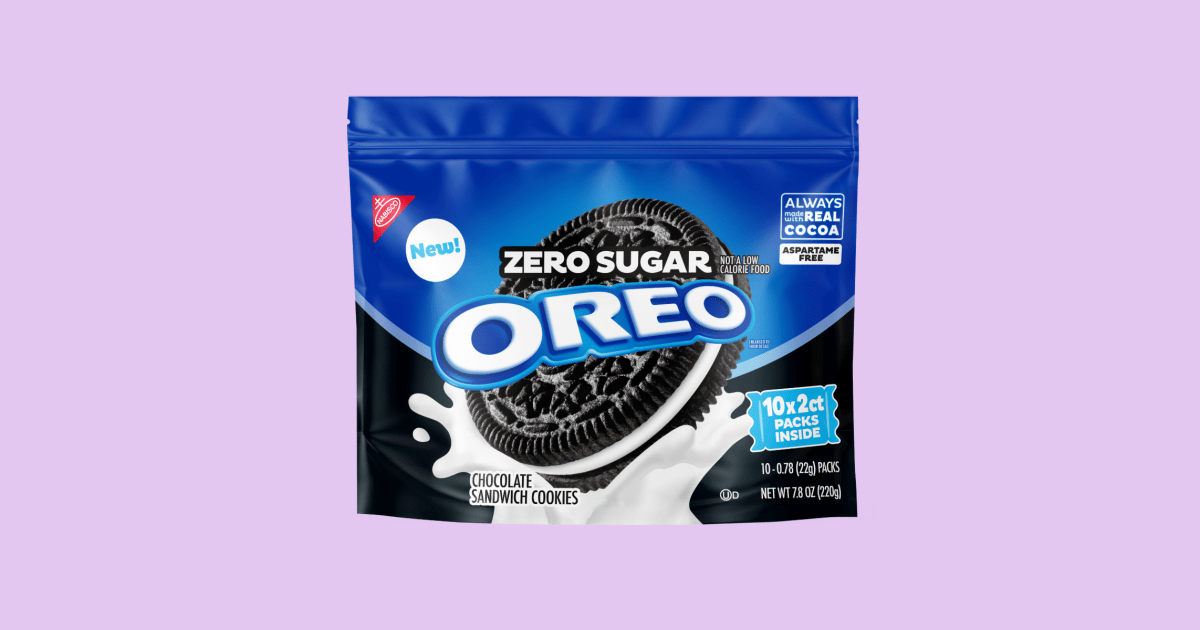
A sugar-free Oreo may sound like an oxymoron, but it’s now a very real thing.
On Dec. 9, Mondelez International announced Oreo Zero Sugar, its first-ever sugar-free cookie sold in the U.S.
The new treat comes in both Original and Double Stuf versions sweetened with a mix of sugar alternatives — maltitol, polydextrose, sucralose and acesulfame potassium (Ace-K) — and, perhaps surprisingly, no aspartame.

In contrast to a classic Oreo, the zero-sugar version comes in a stand-up bag instead of a sleeve, and is preportioned with 2 cookies per pack.
Both sugar-free versions, Original and Double Stuf, will be available permanently at retailers nationwide starting in January 2026.
The brand says in a release that Oreo Zero Sugar can be a “portion control and sweet tooth companion,” while allowing people to keep their “health & wellness goals,” but zero-sugar desserts aren’t necessarily better for you.
Are Oreo Zero Sugar Cookies Healthier?
Oreo Zero Sugar lists the following ingredients: unbleached enriched flour (wheat flour, niacin, reduced iron, thiamine mononitrate, riboflavin, folic acid), maltitol, canola oil, palm oil, polydextrose, cornstarch, cocoa processed with alkali, baking soda and/or calcium phosphate, sorbitol, salt, soy lecithin, chocolate, artificial flavor, sucralose and acesulfame potassium.
The nutrition facts read that each pack of two cookies contains 90 calories, 1 gram saturated fat, 0 grams trans fat, 0 milligrams cholesterol, 2 grams dietary fiber, 0 grams sugar, 6 grams of sugar alcohol and less than 1 gram of protein.
Registered dietitian Natalie Rizzo, nutrition editor for TODAY.com, says a typical Oreo has about 54 calories, which is only slightly more than the 45 in Oreo Zero Sugar. A classic Oreo also has about 5 grams of added sugar per cookie, but its sugar-free companion has ingredients consumers should watch out for.
“Sorbitol is a type of carbohydrate that is less sweet and calorie dense than sugar, but it still has some calories and carbohydrates,” Rizzo says. “It doesn’t spike blood sugar as much as sugar, but it still does affect blood sugar levels a little bit.”
Rizzo notes that eating large amounts of sorbitol has been shown to cause gastrointestinal discomfort, mainly diarrhea, so eating a whole pack of these in one sitting may not be the best idea for one’s stomach.
“Some people with diabetes or those who are watching their sugar intake may opt for sugar-free Oreos to manage blood sugar levels,” she says. “In my opinion, regular and sugar-free Oreos are ultra-processed snacks with little nutritive value, so eat both sparingly.”

Natalie Rizzo, RD contributed.