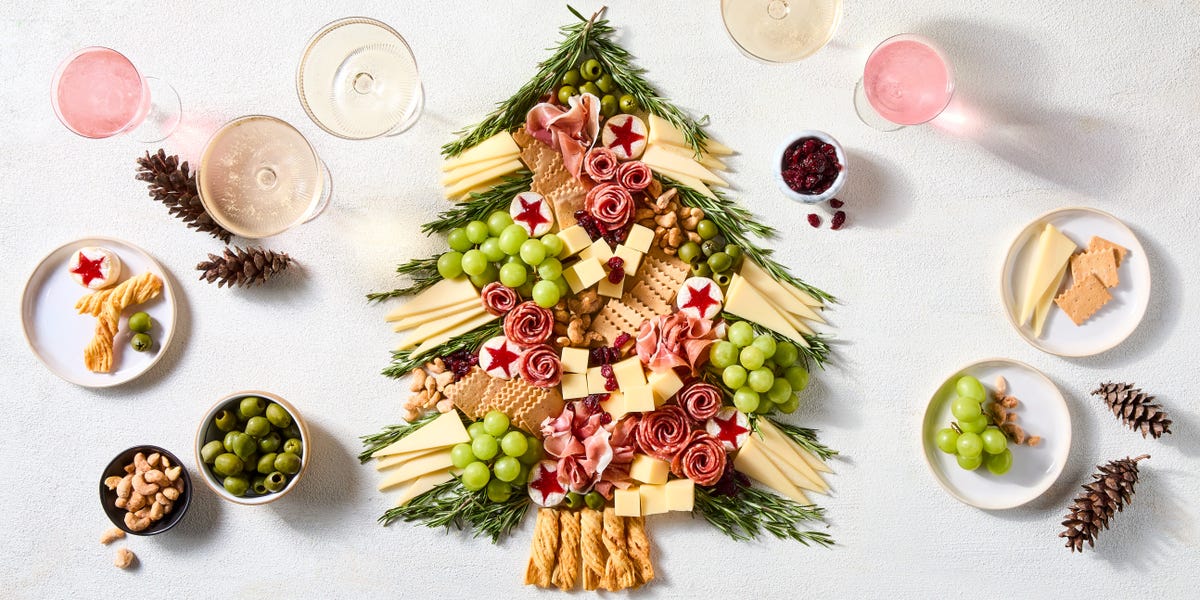
Plain and simple: I love a charcuterie board, and I’ll take any excuse to make one, from holidays to weeknight girl dinners. The meats, the cheeses, the spreads, and all the other sweet and savory bites make for such a fun eating experience. My absolute favorite part about them is that they’re completely customizable, letting you get creative and make each one different every time. If you’re looking for the perfect one this Christmas, you’ve got to make this festive charcute-tree (if you will)—not only is it great to feed a crowd and bring people together, but it also makes for a beautiful holiday centerpiece.
With a little bit of practice, your boards will look professional in no time! Here’s everything you need to know.
How To Make A Christmas Tree Charcuterie Board
INGREDIENTS
What you use to create your board is really up to you. That said, here are some guidelines I like to follow to make my boards feel well-balanced:
- Have at least 2 meats: I like to go for simple Genoa salami and prosciutto. They pair well with pretty much everything and everyone. Sometimes I like to include a spicy one for variety in color and a touch of heat.
- Pick 3 cheeses: Go for a soft cheese, a hard cheese, and something in between. When feeding a big crowd, I like to go for simpler cheeses that pretty much anyone will like. For this board, I used mini brie, Gruyère, and cheddar because they pair well with many things and because they hold their shape pretty well to create the tree. Feel free to experiment with other cheeses, like manchego, truffle Gruyère, or even caramelized-onion cheddar. Just keep in mind its ability to be cut into shapes and what colors you want on your tree.
- Add something sweet: It’s essential to have some jam or honey with all the salty, fatty elements of your board. Hot honey is always a crowd-pleaser that adds a little bit of spice, or you could get a little fancier with some truffle honey. Fig jam is a classic and pairs so well with almost anything, but lately I’ve been loving a sour cherry spread, which is what I used for this board.
- Crackers: All your meats, cheeses, and spreads need a vehicle! From water crackers to flatbreads and mini crostini, the possibilities are endless here; just add what you like. Above all, keep in mind the colors and shapes you want on your board.
- Fun fillers: You’ll want to fill the gaps in your board with more fun bites to balance the richness of everything else. Fruit will add beautiful color and freshness. My go-to is grapes, but you could also add dried fruits. Add something pickly or briny—I’m obsessed with Castelvetrano olives because they have a slight buttery flavor, but go for whatever olive variety you like. They’re also the perfect shape for decorating your charcutetree! Sometimes, I like to add cornichons simply because I love them, but this time around, they didn’t quite fit the vibe. And last but not least, I throw in some nuts. Any variety works, but this time of year I’d recommend something candied or seasoned. Every time I add candied cashews to my boards, they disappear in seconds!
STEP-BY-STEP INSTRUCTIONS
Start by breaking your cheese sticks in half and placing them on your board, side by side. Stack a few on top of each other to create the “trunk” of your tree. Cut the Gruyère block into right triangles that are a maximum of 2 1/2″ to 3″ in length. Cut the triangles carefully into 1/4″ thick slices. You should end up with 24 slices.
Take sets of 4 slices and fan them out with the pointed ends toward the outer edges of your board. Two sets, one on the right and one on the left, toward the top, middle, and bottom of the board. This creates the tiers/outline of your tree.
Cut the white cheddar into 1/2″ to 3/4″ cubes and set them aside for now. Place one salami on a work surface and arrange another a little halfway over it, overlapping them. Repeat with the number of slices needed for each rose: for the small rose, use 3 slices, for the medium rose, use 5, and for the large rose, use 7. You’ll be making 3 sets of 3, a total of 9 roses. Once salami slices are placed overlapping each other, fold all slices in half to create one long half-moon shape. Tightly roll from one end to create the rose. This will be easier if the slices are still cold. Slightly press the roll together in order to hold its shape.


To create the star shapes on your mini brie, gently press the small star cutter on the top. Use a paring knife to help make cuts if needed (use the cookie cutter as a stencil). Use the paring knife to help peel off the rind to reveal a star indent; it should be shallow.


To fill the mini brie with sour cherry spread, use a small spoon to dollop no more than 1/4 tsp. in the middle of the star. Use a toothpick to carefully pull the jam to fill the edges of the star. This should be an even layer; adjust by adding or removing as needed. Beware of any chunks in the jam; it will be harder to spread, so try to spoon on the smoother parts of the spread.


Cut one slice of prosciutto into equal thirds, short way. This way, you get a perfect portion size for guests to grab. Scrunch/pinch the piece from the bottom to let the edges bunch up at the top. You should end up with 3 pieces bunched. Repeat until you create 6. Group and inch them together to form a horizontal bunch. This is one set. You will create 3 sets of 6 (total of 18 pieces of prosciutto.)

Arrange 6 mini brie stars at the top inner corner of the top-most right-hand Gruyère bunch. Add the next one to the bottom inner corner of the top-most left-hand Gruyère bunch. Repeat this step for the rest of your brie stars to create a zigzag pattern.
Add 3 bunches of green grapes, one next to the top-most left-hand brie and Gruyère, the next one by the middle left-hand brie and Gruyère. And the third by the bottom-most left-hand brie and Gruyère. It should be like a zigzag as well.
Arrange flatbread crackers fanned out in 3 diagonal sections. Start from the top left of the tree, then the mid-right, then the bottom left. Use the entire pack, which should be 8 to 10 crackers per section.
Arrange the sets of salami roses. Start near the top right brie & Gruyère. Then the next set would go by the mid-left brie and Gruyère, and the last set should go by the bottom right brie and Gruyère. This is when you can remove the toothpicks because the other items on the board should hold them in place.

Place a prosciutto bunch at the top-left of the tree next to the sourdough crackers. Add the next one under the mid-right brie star and next to the grapes. The last one should go left to the bottom right group of sourdough flatbreads and under the mid-left brie star.
Arrange the cubed white cheddar in the empty spots down the middle of the tree, then place the olives and nuts to fill the other empty spots on your tree. Add a generous amount of rosemary sprigs to serve as your branches, using two longer ones at the top to outline the top of your tree. Finally, finish with a few dried cranberries on the cheddar and the Gruyère.

The full list of ingredients and instructions can be found in the recipe below.
Recipe Tips
- Life hack: Buy pre-cubed cheese to save time! I love to use white cheddar because it’s a pretty basic cheese that’s not too intense, so it should work for any crowd.
- Be gentle: Take your time making cuts and shaping your cheese and cold cuts so as not to rip, crush, or break them, so you get the best shape to the tree. I like to work with them straight out of the fridge, so they hold their shape and are easier to handle.
- The salami roses: If your salami roses are coming undone, don’t fear! Use a toothpick to hold each one together. Place them back in the fridge in a small container with a lid or plastic wrap until all your other ingredients are prepped and you’re ready to build the board. Remove the toothpicks carefully and place them on the board. They should stay intact, and other items on the board should also help to hold them in place.



Feeling lucky? aa888casino’s got you covered! I’ve had some pretty good wins there lately. The site’s easy to use, and the customer service is helpful. Definetly check it out, here is the link aa888casino!
Identifying the right foundation shade can be tough, especially when thinking about different shades of skin like muted olive, gentle summer color, or olive-based skin. Determining your skin tone and undertones—whether golden undertone skin, crisp winter tones, or warm winter color palette—can really help narrow down the options. If you’re asking how to determine your foundation shade or recognize your color season, taking a color season quiz or quiz can be a game-changer. There are online tools online that assist you through color matching process and help you discover how to determine foundation and makeup colors that work with your specific skin tone. Visit this beneficial resource high contrast features for a easy step-by-step color season analysis.
When it comes to fashion and hair color, using digital hair tools or color testing applications lets you try with trends and shades like dark summer shades or vivid winter tones without any permanence. Recognizing your color season—whether you match a soft autumn palette, light spring color palette, or deep winter palette—can help you choose clothing colors and makeup that enhance your inherent complexion. For example, the most suitable colours for yellow undertone skin are different a lot from those perfect for ivory skin tone with pink undertones. Describing your 試験 with these tools here can help everyone find their right tone too!
Ողջույն, ես ուզում էի իմանալ ձեր գինը.
Hello everyone! If you’re working to figure out what season you are, comprehending your skin tone and undertones is vital. For example, if you have ivory skin with yellowish undertones, you might find that earthy autumn hair colors or a fresh deep summer color palette really work for you. Using instruments like color season tests or an electronic color analysis can help confirm whether you fit into categories like soft autumn, dark winter, or light spring, making it less difficult to pick the best makeup and clothing colors.
Also, experimenting with virtual hair color try-on apps or hair dye simulators can be super helpful before settling on a new look. If you want a quick, no-cost seasonal color analysis or a color palette test to get started, explore how to choose foundation — it delivers a uncomplicated way to find your personal color season and browse trendy 2026 hair color ideas that work with your natural tones.