A viral video showing passengers breaking an unspoken flight rule is not going over-easy.
Last month, TikTok user @jordan_hel posted a video documenting a sulphurous in-flight faux pas happening beside her: a couple peeling and eating a mountain of hard-boiled eggs.
“who did I piss off in a former life?” she wrote in the caption.
At six seconds, the video is short and not-so-sweet: Two anonymous passengers eat as the TikToker stares, shell-shocked, covering her nose.
One of the seatmates holds a bowl of over a dozen shells as the other has a second bowl of eggs ready to be consumed. Is the pair paleo, proteinmaxxing or two foxes in disguise after raiding a henhouse?
The TikToker did not respond to TODAY.com’s request for comment, so its anyone’s guess.
She did clarify in the caption, though, that the meal was, “in fact, two dozen peeled hard boiled eggs which were consumed beside a homemade bowl of steamed broccoli for the entire 16 hour flight.”
The video went viral, garnering more than 3.8 million views. While the couple’s protein-forward foible may have broken social mores, it also brought folks together in the comments section.
“WHERES THE AIR MARSHALL,” commented one TikTok user.
“Eggs and steamed broccoli should be considered a flight risk,” wrote another.
“Sorry you got seated next to mr and mrs fart,” joked another.
“People are so disrespectful and disgusting,” wrote another. “There is no way that they thought this was normal??”
What Do Experts Say?
Etiquette expert Elaine Swann, author of “Elaine Swann’s Book of Modern Etiquette,” tells TODAY.com this pair broke more than eggshells that day.
“This is where folks really are not thinking about how what they’re doing impacts other people,” she tells TODAY.com. “I think that’s what was forgotten in that moment.”
Christina Ling, a flight attendant instructor and founder of the Flight Attendant Institute, tells TODAY.com these social rules exist for more than just the meal — the food in your body contributes to the overall air quality, too.
“Flights really put pressure on your stomach, your diaphragm, and you get very flatulent to begin with,” she says. “When you are eating those foods you produce even more flatulence to what the cabin pressure is putting on your body. And, of course, people are going to release it.”
Ling points out that plane passengers are in a confined environment with recirculated air, so they’ll keep on breathing their lunch far after the last bite.
“Guess what is going to happen? Smells,” she explains. “Not only the smell from the food, but from the food in your stomach due to cabin pressure.”
Do’s and Don’ts for Packing an In-Flight Meal
So, what can you eat on a plane that won’t get you trending on social media?
“Bring food that’s easy to eat,” Swann says, noting that “taking up the space of the passengers near you” with a seafood boil is ill-advised.
Do bring:
- Low-odor fruit such as apples, grapes, melons, berries and strawberries
- Vegetables like lettuce, carrots and cucumber that don’t have a strong scent and are “flatulence-free”
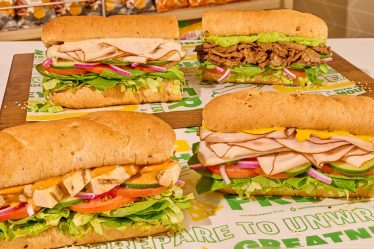
- Simple sandwiches and wraps (turkey and cheese, perhaps)
- Light snacks such as crackers, granola bars, protein bars and pretzels
- Trail mix
- Plain rice cakes
“Do not bring food that is smelly that can impact people negatively,” Swann says, adding that flight attendants don’t have microwaves, so don’t pack popcorn to zap.
Don’t bring:
- Seafood
- Egg-based items, including egg salad and deviled eggs
- Cruciferous vegetables lie broccoli, cauliflower, brussels sprouts, cabbage, onion, especially when they’re cooked
- Garlicky or heavily seasoned food
- Pickled foods
- Kombucha and other strong-smelling drinks
- Strong-smelling cheeses like Limburger, Epoisses and Taleggio
- Strong-smelling produce like durian
From planes to trains and office break rooms, food smells are a subject which elicits strong reactions in polite society as well as online, viral videos and scholarly debate.
A flight in Indonesia was grounded because of durian, which has been banned by many airlines in Asia. Another family was forced to eat 15 pounds of durian they bought before flying.
In the U.S., when a woman went viral for her seatmate’s headscratching snack of tuna fish salad and Greek yogurt, the TSA chimed in:
“Making tuna salad at 30,000 feet? That’s a reel bold move,” wrote the agency. “Sure, your salad might be off the hook, but your seatmate’s face says, ‘I’m not reely loving this.’”
What to Do in a Smelly, Skybound Situtation
The experts say you have a couple of choices if you can’t stand the halibut-and-onion platter wafting your way: You can grin and bear it, or say something to the passenger — nicely.
“Word it to them very diplomatically,” Ling adds.
There’s also a third choice: the flight crew.
“I strongly suggest bringing it up nicely to the cabin crew and saying, ‘You know, I’m sitting next to these people, these eggs, it’s very sensitive to my stomach,’” Swann suggests. “‘Do you think there’s something that you know you can do to help me?’”
If the passenger declines to stop, the crew may offer you a different seat on the plane for your comfort.
Above all, says Ling, “think of your fellow passengers” when packing your lunch. “We just all want to get there from point A to point B, safely, peacefully.”