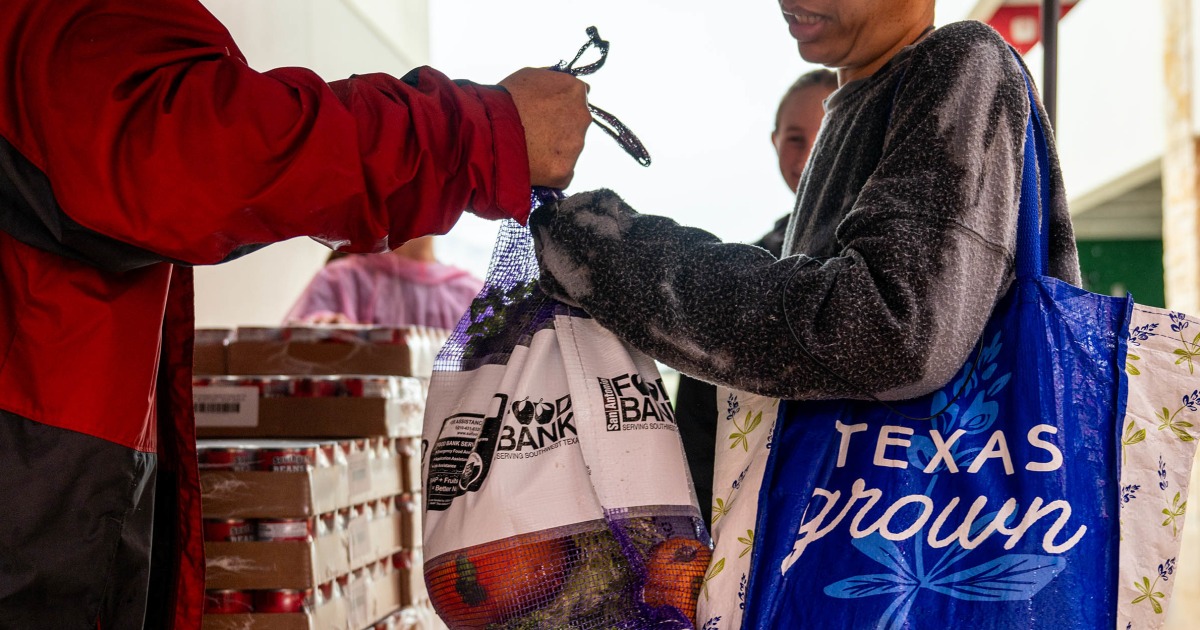
In the middle of summer this year, the San Antonio Food Bank was already feeling some strain. Kids out for summer weren’t getting meals at school, utility prices were at their highest, and the July 4 floods in the area hit thousands of families, hard.
“It’s been a rough 2025,” Eric Cooper, president and CEO of SAFB, tells TODAY.com. “We were responding to that need, and then on Oct. 1, the government shut down. We fight the daily disaster of poverty, but when you add a man-made disaster — like a flood or a shutdown — we respond to that too.”
They’ve doubled the number of shifts in sorting and packing to meet demand.
Cooper tells TODAY.com that last month, federal workers and government contractors started coming to the food bank for help. He recalls a Social Security Administration worker of 30 years raising her four grandchildren, worried she would not be able to feed them, and his organization’s efforts to serve more people by delivering food assistance to TSA workers at the San Antonio airport.
Some workers weren’t just receiving help, though; they were also giving it.
“These are people who have dedicated their lives to service and never thought they’d need help,” Cooper explains, and “what was super inspiring, interesting and humbling was that when we established those extra shifts, we noticed volunteers showing up who were displaced federal workers … They showed up to help us distribute food, in some cases to their own coworkers.”
Although the government is reopening soon, demand is still high due to increased food and energy prices, a tough job market and cuts to programs like SNAP and WIC. For the last couple of weeks, SAFB has served an extra 50,000 people per week, putting them underwater in terms of supplies.
“The challenge of having enough food to meet this demand has been scary,” Cooper says. “We’ve been worried that the demand will outpace the supply. We’re leaning heavily on the inventory in our warehouse — and the holidays are coming.”
So, What’s the Best Way to Help?
The best thing you can give is money.
“We leverage cash,” explains Cooper, “For every dollar we take in, we can put out 10 pounds of food, or seven meals.”
That’s not just by buying food, though; sometimes it’s also paying to move it. The food bank often receives calls from major food companies offering overstock if they can cover transportation, or a farmer might donate a field of food if they can get it harvested.
“That’s ‘food bank magic,’” says Cooper, “which makes a dollar the most powerful gift.”
Still, if cutting a check isn’t possible, there are still plenty of ways to help, and they aren’t picky about what they receive.
“If you have food and can donate it, we’ll take it,” Cooper explains, noting that food drives are usually accepting things people already have in their pantries but don’t need or are willing to part with.

Some creative donation ideas, though, aren’t always practical. Social media posts often encourage donors to put a recipe card in a zippered bag along with the boxed and canned ingredients needed to make chicken potpie or tuna casserole. Or, they might suggest bagging up a birthday pack of boxed cake mix, canned frosting and candles.
That can make great sense for a neighborhood or pop-up food distribution site, but Cooper says that, although such donations are heartfelt, they may not be the most strategic when it comes to food banks.
“Volunteers are asked to inspect and sort food items,” he says, “and some of those themed gifts might be broken down and categorized.”
They understand that both givers and receivers value that feeling of personal connection, though, and that’s why they started their holiday box program.
“A family can pick up a box from us, and on the box are the ingredients that need to go inside,” he says. “Families can even write a message to the receiving family. It’s another way people can connect.”
People Are Showing up for Their Neighbors
Of course, it’s not just Texas food banks feeling the pinch and responding creatively. Feeding America, the nation’s largest hunger-relief organization, says that while the shutdown has put added strain on local food banks, it has also revealed resilience and generosity.
“Amid the uncertainty of the shutdown, our neighbors are showing incredible resolve,” says Monica Lopez Gonzalez, chief marketing and communications officer for Feeding America. “More families are reaching out for help, and it’s heartbreaking when we hear food is running short at distributions. Still, food banks remain undaunted. Together with community partners, we’re doing everything we can to ensure families have the food they need and continue to stand shoulder to shoulder with our communities every step of the way.”
And she agrees with Cooper’s point about the power of a dollar:
“Through Feeding America’s national network and partnerships, food banks can often stretch every dollar further than individuals by purchasing or rescuing food at reduced costs to provide nutritious meals that help our neighbors thrive.”
When in Doubt, Just Ask
So, if you’re wondering whether your nearby community organization needs diapers or pet food, or is short on volunteers, her advice for effective giving is practical — just ask.
“We encourage anyone planning a food donation to check with their local food bank first to see what’s needed most and what items they’re able to accept,” she says. “That simple step helps ensure every gift can be used to nourish our communities in the best way possible.”
And Cooper has some final words of advice on what’s needed most:
“Time is one of the most incredible things, because we all have the same amount. Right now, with heightened demand, there’s a need for more help — in the warehouse, on the farm, in the kitchen and during distribution. It literally brings people to the table.”

For Cooper, the sum of the monetary gifts, personal boxes, food drive bins and volunteer hours add up to something bigger than the parts.
“When I think of food as love, of what’s shared from family to family, this outpouring of support we’re receiving so we can meet this additional demand has been so powerful,” he says. “It’s not sustainable — the gap created by public loss is too big for philanthropy to fill — but it’s amazing to see people do what they can.
“When a community is selfless, that’s the community you want to live in. Those are the values that America is known for.”
If you would like to help, you can donate to Feeding America here. If you need assistance or would like to donate time, food or money locally, you can find a list of food banks in the Feeding America network nationwide here, or contact your municipal or county government.


**mitolyn official**
Mitolyn is a carefully developed, plant-based formula created to help support metabolic efficiency and encourage healthy, lasting weight management.
I don’t think the title of your article matches the content lol. Just kidding, mainly because I had some doubts after reading the article.