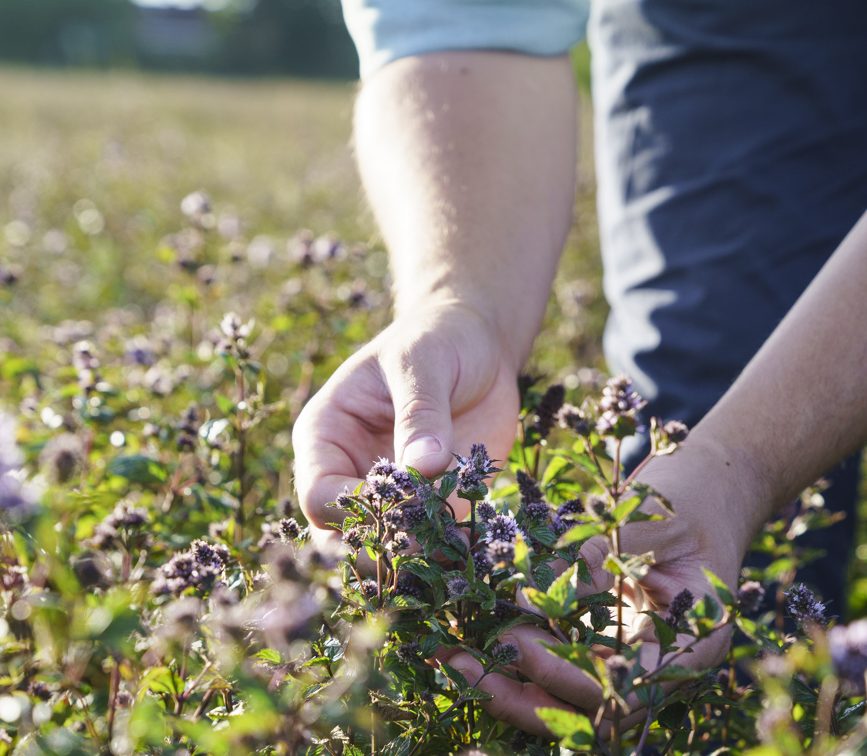
From mustard to peppermint via holistic sustainability; Ruth Davison reveals the hidden depths of one company’s ambition to facilitate positive change – not just for the planet, but for how we live.
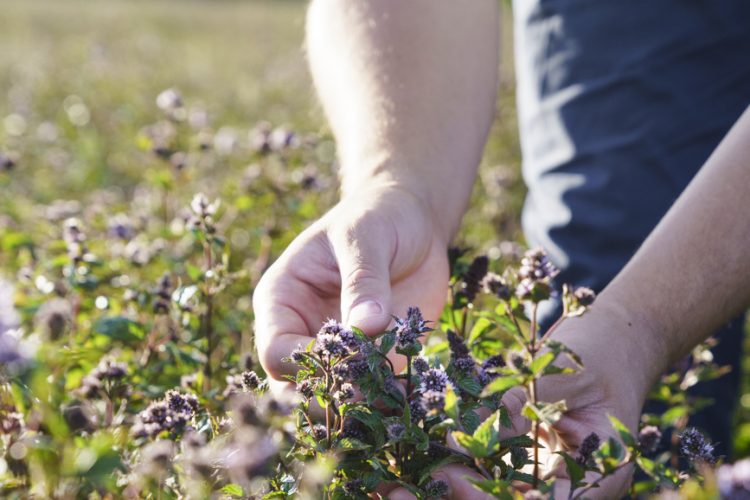
“My grandfather always had a love of strong flavours”, explains Jo Colman, Summerdown’s Chief Mint Officer.
If you recognise Jo’s family name, you are more likely to associate it with mustard than peppermint. Yet the Colman family has now been cultivating Black Mitcham peppermint on its farm in Hampshire for over 30 years.
This belief, and a desire to improve both human and planetary wellbeing, drives Summerdown’s entire business strategy, intrinsically linking sustainability of the business to sustainability of the planet.”
Originally native to the UK, Black Mitcham peppermint had all but disappeared before it was reintroduced to the Colman farm by Jo’s grandfather, Sir Michael Colman, who in 1995 planted cuttings sourced from the US in a corner of a field as an experiment.
Those original plants have flourished to almost 100 acres of peppermint across the family’s farm. From here it is harvested, distilled and barrel-aged on site, before being used to create Summerdown’s own range of luxury chocolates, restorative herbal teas and uplifting body, bath and home fragrance treats.
Yet despite styling themselves as ‘the peppermint people’, sustainability is the beating heart of this company.
Sustainability as business strategy
Thanks to the regenerative agricultural practices Summerdown has adopted over many years, the farm is home to far more than peppermint; it has become a playground for wildlife and insects. Beehives stand on the edges of the mint fields and the team plants special feed crops for birds and sow wildflower seeds annually, encouraging new creatures to make themselves at home in the hedgerows and woodlands.
The approach is clearly working. With one of the rarest wildflowers in Europe – the Greater Venus’s Looking-Glass – growing in the borders surrounding the crops, bird life in abundance and the scent of mint in the air, the farm is producing the world’s finest peppermint oil and using it to create award-winning products.
Summerdown has won over 30 Great Taste Awards, been recognised as BBC Food & Farming’s Best Drinks Producer in 2022 and won multiple Beauty Shortlist awards. But quality product is not the sole goal. Many companies position themselves as ‘business for good’ but as we talk, it is clear how deeply Jo has grappled with this. Our conversation takes a philosophical turn.
“Modern society is predicated on our complete detachment from the natural world,” says Jo, “but I believe that this extractive way of living does not just harm the planet, it leads to deep sadness. As humans, we are made to be connected to place.”
This belief, and a desire to improve both human and planetary wellbeing, drives Summerdown’s entire business strategy, intrinsically linking sustainability of the business to sustainability of the planet.
Enhancing the moment
“We all know the traditional approach – driving the endless consumption of low quality goods – is failing,” says Jo, “and I strongly believe that, with thoughtfulness and intention, we can provide an alternative.”
Of course, Jo wants us all to buy what he describes as Summerdown’s “extraordinary peppermint treats” but not, he explains, for the sake of growth at all costs.
“Our products exist to meet the needs of our customers in the right moments, not to add to the cycle of endless consumerism.”
I ask Jo what that means in reality, and how it is possible to run a business that is dependent on consumption, while advocating for consuming less. He begins with the example of enjoying a mid-afternoon cup of tea –a habit that I enjoy.
“You are going to drink your mid-afternoon cup of tea whether this farm exists or not,” says Jo. “That moment of consumption is going to happen. So, our focus at Summerdown is on making sure we are part of that moment. Our job is to make sure our peppermint tea, which I can confidently say is the best peppermint tea in the world, is available and chosen by you when you had already decided you were going to drink a cup of tea.”
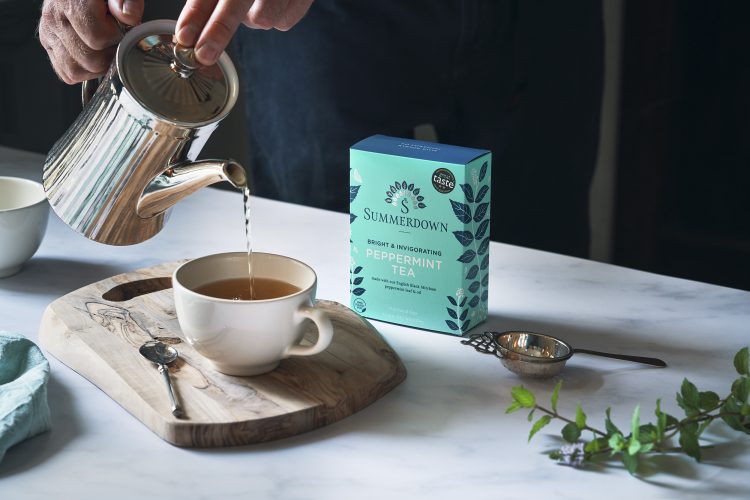
Be it a gift for a friend, an after-dinner chocolate or a relaxing bath at the end of a long day, Summerdown’s goal is to elevate the everyday moments of consumption that already exist with delicious flavours and beautiful scents – not create more of them.
Ensuring that Summerdown products are chosen by consumers over alternatives to enhance an assured moment, is not an easy marketing strategy. But the inevitable focus on high quality demanded by such a strategy, creates a unique and sustainable competitive advantage.
“All of us know that we need to make changes to be more sustainable” Jo notes. “What Summerdown offers [its] retail and hospitality partners is an award winning, amazing tasting, beautifully packaged, carbon-neutral range of products with a strong ‘Best of British’ story. We can help you meet existing demand in a way that enhances your customers’ experience.”
Farming for the future
Jo acknowledges that such an approach is only possible with a long-term view. He recognises both the privilege and responsibility that comes with running a family business.
“This farm is mentioned by name in the Doomsday Book,” reveals Jo. “I have received an invitation to steward it – but just for a moment. I don’t have investors who demand a return on the basis of an expected future. My duty is to future generations and so my focus is on creating something of worth for the future as well as the present.”
Keeping the soil as healthy as possible is a priority for the team, whose goal is to ensure it remains as nutrient-rich as the day it started farming.”
Summerdown could, of course, increase yields and grow profits more rapidly if it considered itself less a custodian and more an exploiter of the land. But this trade of short-term profit against healthy soil that will be productive for years to come – and a business that can be passed to the next generation, – is not one Jo considers.
Keeping the soil as healthy as possible is a priority for the team, whose goal is to ensure it remains as nutrient-rich as the day it started farming. “After all,” says Jo, “that’s the soil our peppermint fell for.”
Jo thinks in 150-year time horizons. Summerdown is already carbon neutral but has an ambitious goal to further reduce its carbon footprint by 40 percent by 2035. Much of the progress against this target will be made by focusing on its packaging, from which it pledged several years ago to eliminate plastic.
And excellent progress has been made.
The company’s pyramid peppermint tea was the first product to be 100 percent plastic free, using Natureflex, a biodegradable cellulose product derived from wood pulp sourced exclusively from responsibly-managed plantations, to wrap the bags inside the recyclable cardboard box. Natureflex is fully compostable. The teabags themselves are made from ‘Tearoad Soilon,’ which is polylactic acid, the base material of which is plant starch.
However, Summerdown encountered quite the challenge when it came to tackling chocolate packaging. Summerdown chocolate bars come in fully compostable packaging but finding a cost-effective alternative to the plastic trays the chocolates sit in has proven impossible, so the company has pivoted. It now focuses on creating a closed loop system, sourcing plastic that is both recycled and recyclable, while watching for technological developments that will make it possible to eradicate all plastic in future.
Zero plastic is a pledge that Jo still wants to honour, but he recognises that the journey will not be linear. For now, Summerdown is certified plastic neutral, working with RePurpose Global to remove as much plastic waste from the environment as they put into it, by supporting a low-value plastic recovery project in India.
Connecting people to nature
Summerdown has been auditing its carbon emissions – including those from its supply chain – for the last three years. With a highly granular, product-level understanding of its emissions, this year the company will go a step further and begin measuring the carbon in its soil. Like so many of its priorities, this will drive both business and sustainability strategies – informing its farming practice and evidencing the health of the ecosystem it nurtures.
This evidence is important as, alongside reducing its carbon footprint and cultivating nature stewardship, connecting people to nature is the third pillar of Summerdown’s strategy.
Summerdown welcomes visitors to stay in shepherd’s huts onsite to experience the farm for themselves through tours and onsite experiences. But for those who cannot visit, its detailed carbon footprint – alongside its B Corp certification and RSPB Fair to Nature Certification – illustrates the impact of its approach.
Understanding the scale of Jo’s ambition, it is important Summerdown’s customers understand how its approach differs from the mainstream. Demand for Summerdown’s products is based on quality, but the wider change it seeks to drive in the world will rely on more people making sustainable choices in more areas of their life.
The vision Jo and his team work towards is a more thoughtful and connected way of life. Inviting people to make this shift via its peppermint products, Summerdown aims to help shape our way of life. That really does feel like business for good.
Meet the author

Ruth Davison, Chief Storyteller at Our Carbon.
Our Carbon supports businesses in achieving product-level granularity in their carbon audits. The company helps businesses make decisions that are better for both the planet and their operations, while also sourcing stories that inspire.


I don’t think the title of your article matches the content lol. Just kidding, mainly because I had some doubts after reading the article.
Thanks for sharing. I read many of your blog posts, cool, your blog is very good.
Your point of view caught my eye and was very interesting. Thanks. I have a question for you. https://accounts.binance.com/register-person?ref=IHJUI7TF
Thanks for sharing. I read many of your blog posts, cool, your blog is very good.
Your point of view caught my eye and was very interesting. Thanks. I have a question for you.
Your point of view caught my eye and was very interesting. Thanks. I have a question for you.
Thanks for sharing. I read many of your blog posts, cool, your blog is very good. https://accounts.binance.info/ES_la/register?ref=VDVEQ78S