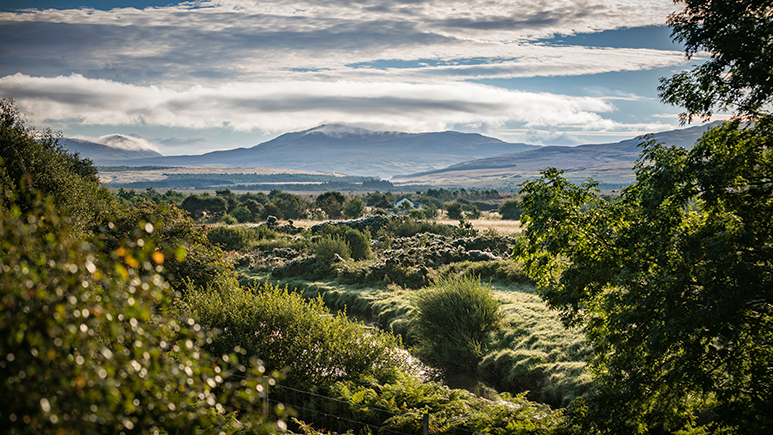
Diageo pledges up to £5 million to restore degraded peatlands across Scotland, safeguarding whisky production, biodiversity and water resources.
Diageo, the maker of Johnnie Walker, Lagavulin and The Singleton, has announced a major environmental investment of up to £5 million over five years to support Scotland’s peatland restoration, aiming to revive 3,000 hectares of degraded peatlands across the country.
Peatlands play an important role in water management, ensuring the sustainability of Scotch whisky’s number one ingredient.”
The drinks giant will partner with Caledonian Climate to identify and co-fund restoration projects that boost carbon storage, enhance biodiversity and improve water management in some of the country’s most fragile and iconic landscapes.
Ewan Andrew, President of Global Supply and Chief Sustainability Officer at Diageo, said: “Restoring and protecting Scotland’s peatlands is essential to addressing climate change, protecting biodiversity and reducing carbon emissions. Peatlands also play an important role in water management, ensuring the sustainability of Scotch whisky’s number one ingredient.”
Peat is a vital natural resource for Scotland’s whisky industry, providing the distinctive smoky flavour in peated Scotch whiskies. But as a natural carbon sink, peatlands are also critical in slowing water run-off, improving water quality and storing carbon. Many, however, are now degraded, releasing carbon and threatening local ecosystems.
Through its new commitment, Diageo aims to help reverse that damage while strengthening the resilience of the landscapes on which its whisky production depends. “Through collective action with other partners and producers, we’ll restore many more times the amount of peat than we will use,” Andrew added. “This ensures we can maintain the traditional smoky flavour of numerous Scotch whiskies, whilst contributing to the conservation of Scotland’s landscapes.”
Scaling restoration through collaboration
Caledonian Climate will lead the restoration programme, collaborating with scientific experts, landowners, local communities, NGOs and conservation groups to deliver best-practice restoration with measurable results. Progress will be monitored across carbon storage, biodiversity and water resilience, supported by a partnership with Wetlands International.
This collaboration with Diageo and Caledonian Climate will restore huge amounts of degraded Scottish peatlands for the benefit of people, nature and climate.”
“We’re delighted to manage this ambitious investment for Diageo,” said Freddie Ingleby, Managing Director at Caledonian Climate. “Their collaborative approach, bringing together scientific experts, landowners, communities and NGOs, will accelerate peatland restoration at scale across Scotland.”
The projects will also build on improved scientific understanding of peatland ecosystems, combining private funding with public initiatives such as the Scottish Government’s Peatland Action Fund. Diageo will seek co-funding from other distilleries and industry stakeholders to expand the reach and impact of the restoration efforts. Among the initial projects is a collaboration with the RSPB on the Oa nature reserve on Islay.
Coenraad Krijger, CEO at Wetlands International, said: “Healthy peatlands are extraordinary climate champions, not only capturing carbon that mitigates climate change, but also storing water that helps reduce flooding and alleviate droughts. This collaboration with Diageo and Caledonian Climate will restore huge amounts of degraded Scottish peatlands for the benefit of people, nature and climate.”
In addition to the Scotland peatlands restoration work, Diageo is advancing innovation in its maltings operations to reduce peat use in whisky production. Since trials began in spring 2024, the company has achieved a five percent reduction in peat required per tonne of malted barley. It is also exploring how peat smoke could be recirculated in the maltings and assessing the potential for reusing displaced peat from infrastructure projects.
By taking what it calls a “science-based approach”, Diageo plans to share its learnings across the Scotch whisky sector to drive wider environmental gains.
New Diageo CEO announcement
The announcement coincides with the appointment of Sir Dave Lewis as Diageo’s next Chief Executive Officer, effective 1 January 2026. The former Tesco CEO and Unilever executive brings extensive experience in global consumer goods and corporate transformation. Lewis, who chairs consumer healthcare company Haleon and serves as a non-executive director at PepsiCo, will lead Diageo into its next phase of growth.


I don’t think the title of your article matches the content lol. Just kidding, mainly because I had some doubts after reading the article. https://www.binance.info/register?ref=IXBIAFVY
Your article helped me a lot, is there any more related content? Thanks! https://accounts.binance.info/ES_la/register?ref=VDVEQ78S
Thank you for your sharing. I am worried that I lack creative ideas. It is your article that makes me full of hope. Thank you. But, I have a question, can you help me?